



William P. Nisbet (far right) with three of his children ca. 1910.
FROM PIPE DREAM TO UTAH TRADITION
During the Great Depression, Salt Lake City resident William P. Nisbet envisioned a pipe band that would honor Utah’s Scottish immigrants while representing the state both locally and across the country. Nisbet, who had come to the United States from Scotland at the age of 19, imagined something ambitious: the Western United States' premier pipe-and-drum ensemble, featuring at least 20 pipers, six drummers, and a troupe of Highland dancers, all dressed in full regalia. In 1937, he joined with other Scottish immigrants and community members to finally establish the Utah Pipe Band (UPB), also called the "Utah Scottish Bagpipe Band" in its early days.
"The organization is to be State-wide, neither religious, political, or have any social discrimination," the UPB organizers stated in an early band document, "and its primary objective is the welfare of our City and State, with its splendid citizenship, regardless of whether they be Mormons, Catholics, Jews, Presbyterians, etc. or affiliated with any fraternal organization . . . ."
The band quickly became a fixture at community gatherings, performing at Scottish reunions, Lagoon Amusement Park, and other local events. One of its
most significant roles, however, was its participation in Covered Wagon Days (now known as Pioneer Day), highlighted by the annual parade in Salt Lake City. This official Utah holiday commemorates the arrival of the Latter-day Saint or “Mormon” pioneers to the Salt Lake Valley on July 24, 1847. To this day, celebrations along the Wasatch Front rival those of Independence Day. Since its founding, the UPB has marched in every Pioneer Day parade, a cherished Utah tradition and one of the oldest parades in the U.S.


BUILDING THE BAND
From the outset, the founders of the UPB began preparing for an important upcoming milestone for Utahns: the 1947 Pioneer Day centennial. They had members to recruit, instruments to obtain, full Highland gear to acquire, and musicians and dancers to train. Some of these supplies—such as kilts and other regalia—were painstakingly made at home while others were shipped to Utah by band members' relatives in Scotland.
The band’s progress was detailed in a document from a UPB meeting in 1939:


At the present time, we have a group of twelve young boys and girls with several young men, who are already proficient in the playing of the pipes, practicing regularly on the Chanter, that is, the mouthpiece of the bagpipes. However, it takes about $50.00 to $75.00 for a complete set of pipes, and the Highland costumes would take another $30.00 to $50.00 so that to fully equip the band, it will run around $100.00 per member.
To raise funds for this, it is proposed to hold a concert in Salt Lake City sometime during March or early April, also sell tickets and solicit small donations throughout the City and State, as that it will become a Community Enterpirse [sic.], and not be confined to just a few people or to any one organization.

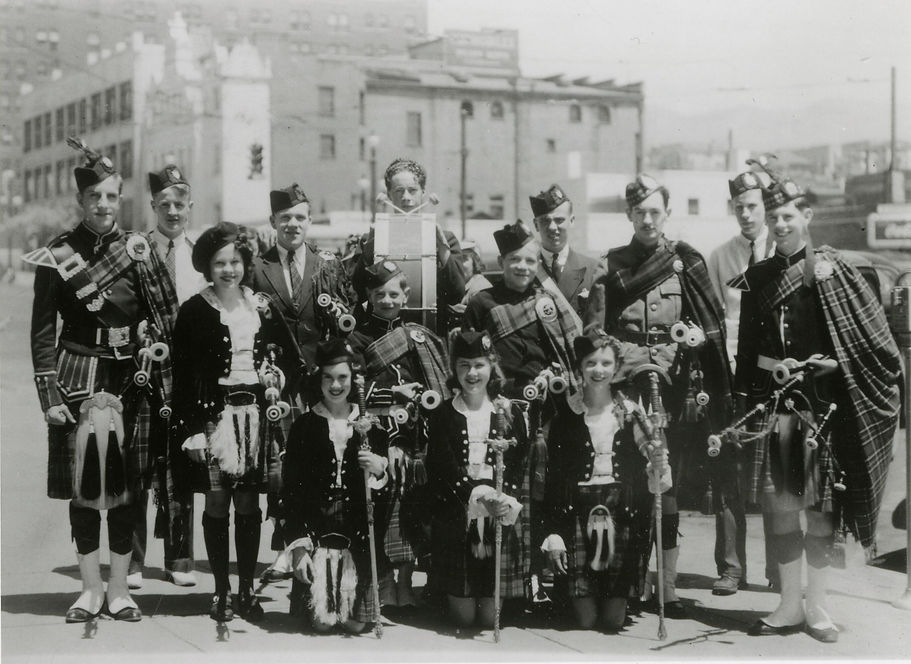
The Utah Pipe Band at the Scottish Missionary Society Reunion, April 1938.
L–R, top: (1) Joseph "Joe" Marshall McPhie, (2) Charles "Stuart" Donaldson, Jr., (3) Afton Mary Erskine, (4) George Thompson, (5) David "Dave" Darrel Barclay, (6) Ralph Marshall on bass drum, (7) Harry Erskine, (8) Vernon Anderson, (9) James Douglas "Doug" Nisbet, (10) Glenn Irvine, (11) Robert "Bob" Andrew Barclay. Bottom: (12) Mary Afton Barclay, (13) Ruth Erskine,
(14) Margaret McPhie
"ACT WELL THY PART"
Among the UPB’s most enthusiastic supporters was David O. McKay, president of the Salt Lake City–based Church of Jesus Christ of Latter-day Saints from 1951 to 1970. Born in Utah to a Scottish father and Welsh mother, McKay spent part of his early adulthood as a missionary in Scotland. While in the city of Stirling, he spotted an inscription above the doorway of a building, which read, “What e’er thou art, act well thy part.” This phrase resonated with McKay, and he referenced it often throughout the rest of his life.
In keeping with tradition, McKay regularly participated in Salt Lake City’s annual Pioneer Day parade and consistently arranged for the UPB to follow directly behind him. His ongoing connection with the band contributed to the UPB’s identity at the time, and McKay was named Honorary President of the Utah Pipe Band as early as 1939. “Act well thy part” later became the band’s motto.
SNAPSHOTS OF A LEGACY
 The Utah Pipe Band ca. 1937. L–R, Back: Robert "Bob" Barclay, George Thompson, Ralph Marshall, Vernon Anderson, Douglas "Doug" Nisbet, Afton Erskine. Front: Margaret McPhie, Mary Barclay, Dave Barclay, Harry Erskine. |  Members of the Utah Pipe Band pose for the camera ca. 1940. |  The UPB greets British actress Dame Gracie Fields at Salt Lake City Airport during WWII. Fields had come to the United States on a fundraising tour for the war effort. |
|---|---|---|
 The UPB plays for actor Orson Welles in 1947. Welles was in Utah to perform a stage production of Shakespeare's "Macbeth" before filming a Hollywood adaption of the play. The play took place at the University of Utah's Kingsbury Hall, and the Hollywood production was released in 1948. UPB pipers Dave Barclay, Bob Barclay, and Dale Blain performed on the pipes as part of the play. L–R: Dave Barclay, Orson Welles, Bob Barclay, Dale Blain. | 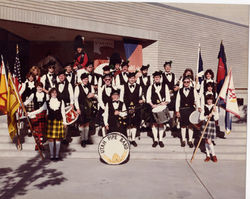 The UPB at the Pioneer Day Parade in Salt Lake City ca. 1978. |  UPB pipers warming up (ca. 1980). |
 The UPB ca. 1978. |  The UPB competes ca. 1980. |  UPB pipers meet Utah Governor Scott Matheson in 1983 as he signs the Scottish Heritage Proclamation. L–R: Steven Wainwright, -uncertain-, Scott Matheson, John Burke, Wanda McDonough. Burke and McDonough were visiting as representatives of the Utah Scottish Association. |
 The UPB ca. 1990. |  The UPB ca. 1990. |  Highland dancers perform with the UPB ca. 2012. |
 The UPB ca. 2012 |  The UPB competes in Pleasanton, California, ca. 2018 |  The UPB plays at the USS Missouri in Hawaii. The band had been invited to perform at the 80th anniversary of the 1941 attack on Pearl Harbor. |
 UPB tenor drummers prepare for a performance in Taylorsville, Utah, in 2023. |  The UPB performs in Normandy, France, in 2025. The band had been invited to perform for the Victory in Europe (VE) Day celebrations. VE Day commemorates the end of WWII in Europe in 1945. In 2024, the UPB and Barclay School of Highland Dance had also performed in Normandy for the 80th anniversary of the D-Day invasion of France on June 6, 1944. |  The UPB practicing for their annual concert in 2025. |
 The UPB and Highland dancers from the Barclay School of Highland Dance perform at their annual concert in 2026. |  UPB Pipe Major Andrew Barclay warms up before performing in concert in 2026. |  The UPB performs at the Salt Lake Tabernacle in 2026. L–R: Matt Judd and John Barclay. |