

ANGUS CRAIG
Director/Trustee
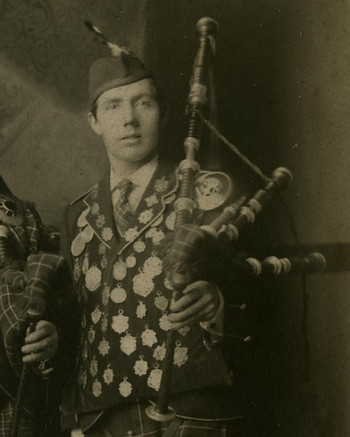
Angus Craig ca. 1914.
The Three Macs
Angus Craig was born April 11, 1886, in Oban, Argyll, Scotland. He died March 9, 1981, in Freeland, Washington, USA. His father was William McKenzie Craig (1845–1924), and his mother was Elizabeth Craig (née McPhie, 1853–1937).
Craig's family lived in the Govan district of Glasgow before emigrating to the United States. A gifted Highland piper and dancer, Craig competed in numerous bagpipe competitions as a young man in Scotland. He continued performing and competing after coming to the U.S. in 1906 at the age of 20. The family's first U.S. residence was in Ogden, Utah.
Craig performed frequently with his sister and youngest sibling, Elizabeth "Bessie" Craig (1894–1989), a Highland dancer. They had been in the U.S. only a few months before deciding to become acquainted with their new country as traveling entertainers. This was spurred by an encounter with 21-year-old
Frederick “Fred” Lundgren Goddard (1886–1956), who had seen the Craigs perform at a Robert Burns celebration in January 1907. Goddard, who was Utah-born and of English and Swedish stock, was impressed by their performance and asked Angus Craig to teach him Scottish dancing the next day. Through intense nightly practice, he quickly mastered the Highland Fling and the Sword Dance.
%20and%20Angus%20Craig%20(right)_edited.jpg)
Angus Craig (right) and his sister, Bessie Craig. It was the style at the time for Highland competitors to display the medals they had won on their clothing or on a removable apron. Dancers were known to keep the medals attached while dancing, even during competition. After the formation of the Utah Pipe Band in 1937, Bessie performed with dancers from the UPB at Scottish community events.
Before long, the two Craig siblings joined forces with Goddard and entered the vaudeville circuit, touring the American West, Midwest, and South. Goddard assumed the stage name “Bruce MacKenzie,” and the group christened themselves “The Macs Troupe of International Dancers” (more commonly billed as “The Three Macs”). On April 1, 1907, the group debuted in Salt Lake City with an act that blended Highland dancing, comedy, and bagpipe music. Bessie Craig was only 13 years old at the outset of The Macs’ adventure and studied textbooks to keep up with her education while on tour.
Goddard’s letters home offer insight into vaudeville life: delays caused by rail accidents, long walks into unfamiliar towns, canceled performances, missed trains, blizzards, and dressing rooms kept warm by small fires. Just as frequent, however, were the packed theaters and a steady stream of invitations to dinners, boat rides, and parties, sometimes for days on end.
While in Minnesota, the trio briefly merged with another act known as “The Musical DeFays,” forming the short-lived DeFay-Mac Comedy Company. Although the collaboration was popular with audiences, it demanded a lot from the performers. Goddard wrote:
“We scored a big success in every town, but the work was too strenuous for us all, and we dissolved partnership. In addition to my regular dancing, I had to impersonate a tragedian, comedian and a crazy character. Although I enjoyed it immensely, still I didn't enjoy putting on three different layers of paint on my face, with three minutes to make each change of costume every night, so we thought it best to go back to dear old easy vaudeville."

The Three Macs. L–R: Fred Goddard (stage name "Bruce MacKenzie"), Bessie Craig, and Angus Craig.
Newspapers along their route beckoned readers to witness the Scottish performers who claimed "the distinction of having won over one hundred gold and silver prizes which they [wore] upon the stage.” One advertisement joked, “One of them tortures the instrument and squeezes out a lot of funny noises, which pass for music in the highlands,” while another praised them as “one of the most popular and artistic acts that has been put on.”
After The Mac's 1907 vaudeville tour, Bessie Craig and Goddard returned to Utah. Angus Craig headed to Lead, South Dakota, after being asked by Clan Stewart No. 140 of the Order of Scottish Clans (OSC) to play the pipes for their Robert Burns celebration in January 1908. The "Hundred Medal Piper," as Craig was called, felt at home in Lead and remained there for two years. Here, he was installed as Clan Stewart's financial secretary.
Craig returned to Utah in 1910, where he joined the Salt Lake Thistle Club and became the organization's pipe major. The following year, Clan Stewart No. 207 of the OSC was established in Salt Lake City, and Craig was installed
A Break From Vaudeville
as the organization's treasurer. He also played with the Clan Stewart Bagpipe Band, which entertained audiences not only at club functions but also public events, including statewide vaudeville shows.

The Clan Stewart Bagpipe Band & Dancers ca. 1914. Photo taken by Krueger Studio in the American Theatre building (241 S. Main St., Salt Lake City, Utah). L–R, top row: (1) Unidentified, (2) Frederick Lundberg Goddard, (3) Uncertain. Middle row: (4) James Boon Hamilton, (5) Unidentified, (6) Unidentified, (7) Uncertain, (8) Unidentified, (9) Unidentified, (10) Angus Craig. Front row with violin: (11) Andrew Fleming Strathearn
In 1911, Craig married Scottish-born Margaret "Maggie" Orr Irvine (1888–1974). The two had met each other earlier that year at a party in Salt Lake City, where Craig chose one of the lady's hats that had been left out, put it on his head, and announced that he would walk its owner home. The next year, the two had a son, Douglas Irvine Craig (1912–2008).
In 1915, the wheels were set in motion to merge the Salt Lake Thistle Club, Clan Stewart No. 207, and the Salt Lake Caledonian Club into a single organization: the Salt Lake Scottish Club. The merger was completed by 1916, and Craig became the pipe major for the new club's pipe band.
Touring with Harry Lauder
During the First World War, renowned Scottish comedian and singer Harry Lauder (1870–1950) was on a vaudeville tour of the U.S. with a pipe band of his own. His son and only child, Capt. John Currie Lauder (1891–1916), had been killed in action in France, and Lauder dedicated himself to providing comic relief to Allied troops on the front lines and raising funds for the war effort on his tours. Fresh from recording a short film with Charlie Chaplin in Los Angeles, Lauder was in Salt Lake City in January 1918 and found himself short a piper. Having heard of Craig's skill on the great Highland bagpipes, Lauder offered him a place in the band, which also included Pipe Major Angus Fraser, Hugh McDonald, James Williamson, George Black, and Alex Monro—some of the foremost Highland pipers and dancers in the U.S. at the time. For the next 18 months, Craig toured the country with the popular entertainer, who at one point in his career was the highest-paid performer in the world. In 1919, King George V of the United Kingdom conferred Knighthood upon Lauder for his work during WWI. Lauder and Craig were reunited on at least one occasion in 1929 at one of Lauder's shows in San Francisco.

Sir Harry Lauder in 1919
California, the Utah Pipe Band, & Later Life
After touring with Lauder, Craig continued performing in Utah on radio shows and at venues such as Saltair. The Salt Lake Herald dubbed him a "Scotch bagpipe artist of national reputation" and touted that he had "won many medals and a great deal of fame for his exceptional work as a player of pipes." It was at around this same time that he moved with his family to Oakland, California.

Angus and Margaret Craig at their 50th wedding anniversary in 1961.
At the time of the Utah Pipe Band's creation, Craig had returned to Salt Lake City for a number of months and was one of the band's first directors, trustees, and instructors. Among the other cofounders were his brother (Charles Craig) and his cousin (Daniel M. McPhie).
In California, Craig was the official piper of Clan MacDonald No. 79 of the OSC, the director of the Stewart Troupe of International Dancers and Bag-pipe Band, the piper and orchestra leader for the St. Andrew's Society of Oakland, and a member of the Oakland Kiltie Band. As of 1961, he was working as a construction supervisor. He was a carpenter by trade and had worked in both the housing and shipbuilding industries throughout his adult life.
In the early 1970s, the Craigs moved near their son, Douglas Craig, in Washington state. Margaret Craig died in 1974. Angus Craig died in 1981 at the age of 95.